By: Emma Kwee
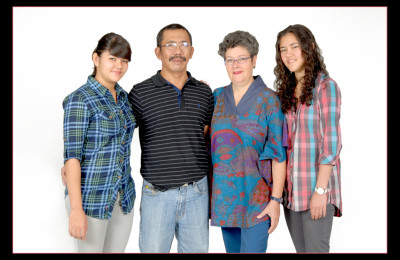
Time for another addition to our ever growing ‘family’ of cross-cultural couples. Read about the other cross-cultural couples that shared their story. Sita and Oka met in 1984 in The Hague, the Netherlands. They live on Bali and have two stunning children, Bika and Amba. Sita tells us how she met her husband and how their Balbel (Bali-Belanda) marriage developed.
Can you introduce yourself to our readers? Sita: ‘I am Sita van Bemmelen, born in 1954, Groningen, the Netherlands. When my father was in college, he learned Sanskrit, just for the fun of it. That is why my name is not a regular Dutch name: Sita is the main female character in the Indian epos Rayamana. Perhaps I was destined to end up marrying a Hindu, never mind he is not from India, but from Bali, Indonesia. My husband is Ida Bagus Oka Sumarjaya Pidada, born in 1958, Klungkung, Bali. We have two beautiful and clever Balbel daughters: Ida Ayu Amba Mathilde (1991) and Ida Ayu Bika Alice (1994), both born in Jakarta. Excuse me for displaying parental pride!’
By: Sita van Bemmelen
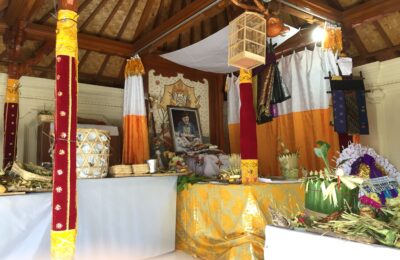
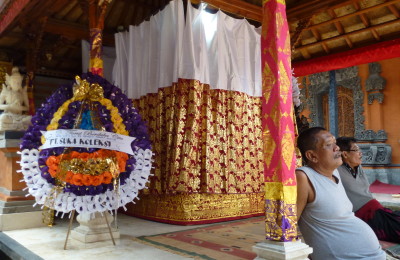
The first time I witnessed a ritual washing of the corpse, it was a rather confrontational experience. However, that was not the only time, I felt uneasy. But before I come to that, let us first have a look at what happens after the ritual washing: the sequence of a cremation.
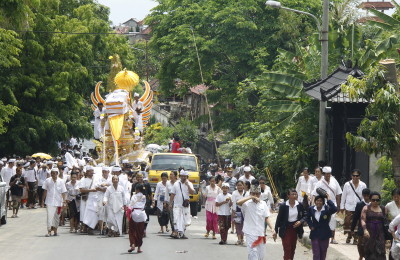
On the day of the cremation, the chest with the remains of the deceased will be brought out of the family courtyard and put in a container (wadah) placed on the side of the road. That container can be an elaborately decorated and multistoried tower, for which Balinese cremations of royal families are so famous. But often it is a much simpler affair. The wadah will be hoisted on a rack made of bamboo and carried to the cremation field called setra by as many men as needed, depending on the weight of the tower. They can number up to a hundred men. Usually the wadah is brought to the setra around mid-midday, so one can imagine how heavy the task of the bearers is.
By: Sita van Bemmelen
Death is a neat affair in the Netherlands, the country where I come from. The only and last relative that I have seen laid in state at home was my grandmother from father’s side, when I was fifteen years old. My other grandparents, my parents and other relatives were all brought to an undertaker’s facility after they had passed away. Someone not known to us laid them off. We could take our leave of them in a solemn room, laying groomed in a nicely upholstered chest and surrounded by beautiful flower arrangements. Still, even a confrontation as benign as this, is often considered a sight unsuitable for the eyes of young children.
Death is thus a matter to be dealt with delicately; sordid details must be tucked away. We do not directly witness the decomposition of the corpse in case of a burial or disposal by fire when cremated. Of course, the covert nature of the proceedings does not diminish the feelings of loss and grief, but perhaps it helps to keep an untarnished memory of a beloved relative or friend, something that is cherished.
By: Sita van Bemmelen
The world is getting smaller every day. This implies that parents may wish to equip their children with the social skills to take full advantage of global integration. Children of expatriate parents already have a relative advantage in this respect compared to others, as they are accustomed to adapt to different cultural environments since they were young. But how can parents create the opportunity for their children of having a similar experience, albeit for a more limited period of time?
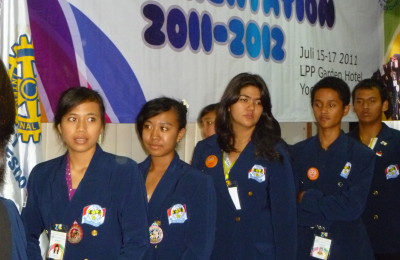
The path chosen most often is sending kids abroad for a university education after their high school graduation or after they hold a bachelor’s degree. Abroad they usually stay on a university campus or in a private boarding house. There they meet many other students from the host- and other countries who share their own predicament of having to find their way. However, whether he or she will develop the social skills for international communication depends very much on his or her adaptability and inclination. Perhaps it is just too much for them and they stay within their comfort zone, communicating primarily with other young people from their home country who happen to be living in the same place.
By: Sita van Bemmelen
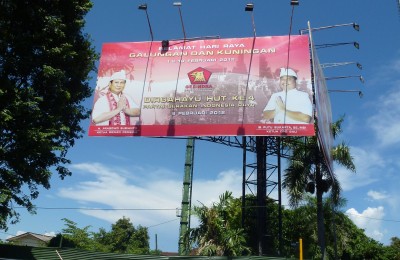
Indonesia entered a new phase in its existence as a nation in 1998, when President Suharto stepped down as the result of massive protests against his thirty-two reign. One of the many grievances was the governments’ centralistic nature. Taking this grievance seriously, in 2002 a law was accepted transferring part of the central government’s power to the level of the district in 2002. This and the concomitant introduction of direct elections for the offices of governors of provinces, heads of districts and members of the legislative councils led to a revival of regional politics. That arena had been dull in the past, because during the Suharto period the bureaucrats were appointed by the central government and the members of the legislative council by the top of three parties in Jakarta.
The political constellation has thus changed significantly and this is occasionally reflected in telling ways. For example, in the billboards appearing alongside the arteries of the city of Denpasar, the capital of the island of Bali, on the eve of the most important Hindu-Balinese religious ceremonies, Galungan and Kuningan. On many of these billboards expressing good wishes to the Hindu population during the celebration of these holy days, the head of a party at the national level on left side and on the right the head of the party on the regional level are depicted.
By: Sita van Bemmelen
There are a thousand ways of falling into the abyss, dividing people of different cultures. But you can also view being of different countries and cultures as an opportunity and try capitalizing on it. Over the years in Bali, my husband has become a trusted partner of several Dutch businessmen or people who wanted to build a villa in Bali. Oka has five assets that make him ideally situated for this role: his accounting skills, his mastery of the Dutch and English language, his Indonesian way of dealing with people who work for him, his access to the Indonesian bureaucracy (partly due to his family background) and, last but not least, his honesty.
One often finds, that foreigners like to work with locally based foreigners because they are inclined to trust a fellow-country man or woman more than a local. However, foreigners rarely possess all five assets mentioned. Of course, at first foreigners do not always realize the benefit of working with a local person like Oka. It takes time and word of mouth to build a good name. I do not know whether the fact that Oka has a Dutch wife, has helped him gaining trust. But I am sure, that it has not played a significant role, because I have never been part of his projects with foreigners, let alone interfere with it.
By: Sita van Bemmelen
Mixed married couples in Indonesia often face demands from relatives of the Indonesian spouse. It is a very entrenched idea among Indonesians that a foreign spouse from the West or a wealthier Indonesian country in Asia (Japan, Korea) must be rich. It rarely dawns upon them that contrary to Indonesian parents who often continue supporting their married children financially, parents in the West are less inclined to do so, being of the opinion that once their children have become adults, they should take care of themselves.
By: Sita van Bemmelen
Money, in particular when one thinks there is not enough of it, can be a source of exacerbating conflict between husband and wife. Fortunately, we have never had a quarrel about money, despite the fact that there have been times when things were ‘rough’. Indonesia’s economy is volatile. When we moved to Indonesia in 1991, we had again the luck of making a good start, because during the first five years I earned a comfortable expat salary. Oka soon found work as well as accountant, first for an American project, later at the Dutch chamber of commerce. During these years, we earned enough to start building a house on a plot of land that we had already bought in Denpasar in 1989. My parents also helped to make this possible. After my contract was over, we moved from the house that had been rented by my employer for the period of my contract to a house in a real estate complex in Depok. I did not mind us staying in Indonesia and try living a normal ‘Indonesian’ life. I viewed as a challenge.
By: Sita van Bemmelen
Mixed couples often have to deal with overcoming cultural, religious and economical differences. Read all about my marriage to my Balinese husband my interview for the Latitudes Cross-Cultural Couples series.
Another problem that may trouble the relationship is the fact that societies do not necessarily grant rights to women and men in the same way. For example, Bali is a patrilineal society. This means that daughters do not have the right to inherit and that children are conceived of as belonging to the husband and his family. In case of divorce, the children are usually allocated to the husband, and if a widow wishes to remarry, the children are often claimed by the family of her deceased husband.
By: Sita van Bemmelen
In my experience, the airport is a place full of surprises. From time to time I meet people there by chance whom I haven’t seen in ages. The other day I met Mrs. Kartika, who immediately walked up to me, pecking a neat kiss on each of my cheeks. She used to be the head of the regional bureau for women’s empowerment a few years ago. During the two years she had filled that position she never seemed confident and more than once had whispered to me that she still needed to learn a lot. But although she had asked me several times to give a talk or facilitate a meeting organized by her bureau, we never exchanged more than the usual pleasantries. This time, however, we unexpectedly ended up in a serious conversation about family matters.
An Ida Bagus
‘Aren’t you and your husband afraid that your daughter will get involved with a non-Balinese young man now that she is studying in the Netherlands?’ she inquired after I had told her how my family was doing. ‘Well, that is of course a possibility’, I answered lightheartedly,’ but let’s wait and see. My husband and I too would of course be happy if she returns to Indonesia after she has finished her studies’. ‘And did the family agree that you let her go?’ she pressed on, looking me suddenly squarely in the eye. Sensing that she would appreciate it if I gave her an honest answer, I told her that perhaps my husband’s relatives had misgivings about that, but had not expressed these directly to us. ‘But don’t they prefer your daughter to marry an Ida Bagus?’ she persisted. ‘Hmm, yes, of course they do’, I conceded, ‘for our family, a husband for the girls has to come from a Brahman family. But preferably he has to have a good education too. It’s like what my sister-in-law told my daughter: “Dayu, look for an Ida Bagus who is a doctor!” Clearly relieved that I understood the way of thinking of Balinese high caste families, Mrs Kartika’s face brightened: ‘Yes, that would be the ideal match!’
With 17,508 islands Indonesia has it all: bustling cities, green rice paddies & glorious beaches. Read all about it in our Indonesia travel guide.
Malaysia, truly Asia! Read about multicultural Malaysia, the people, the culture & the food in our Malaysia travel guide.
The city state of Singapore is an eclectic metropolis. Get to know the hot spots & explore the urban jungle with our Singapore travel guide.